Skip to main navigation menu Skip to main content Skip to site footer

Volume 17, No. 1-2

Published December 31, 2025

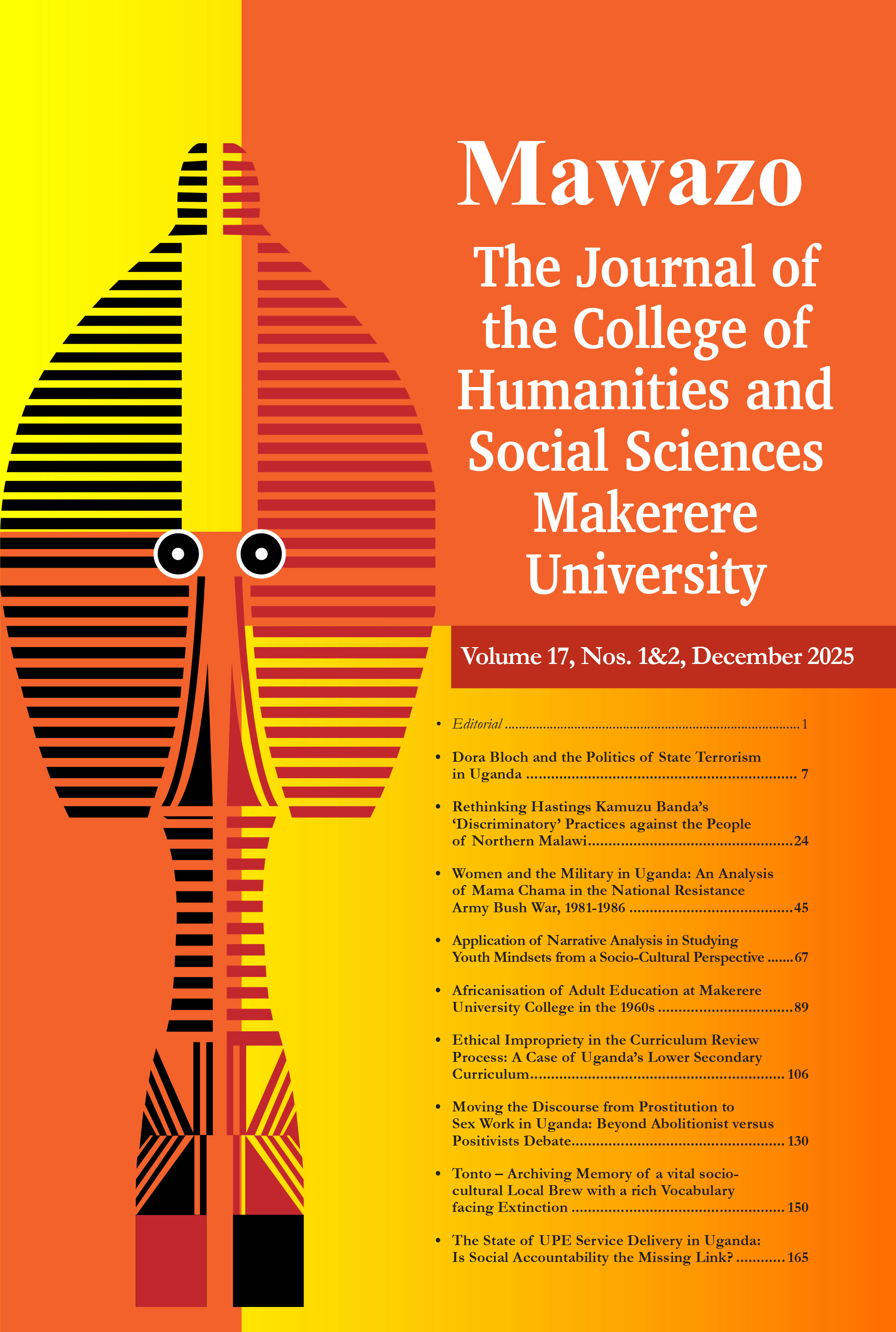
Vol. 17 No. 1-2 (2025)

Articles

  1. Dora Bloch and the Politics of State Terrorism in Uganda

    On June 28, 1976, France’s Airbus 139 with over 240 passengers was hijacked by the Popular Front for Liberation Palestine (PFLP), a branch of the Palestinian Liberation Organisation (PLO), and landed at Entebbe airport. This was the first international hostage-taking terrorist incident in Uganda. The hijackers released non-Jews but refused to release Jews. On 4 July 1976, the Israeli military carried out a mission to rescue Jews. However, Mrs.. Dora Bloch (British-Israeli), who had been hospitalised in Mulago was left behind. She disappeared from the hospital, and her remains were discovered in 1979 after the overthrow of Idi Amin. Mrs. Bloch’s disappearance raised questions regarding state terrorism, how it manifested, and its impact on Uganda’s geopolitical standing and relations with Israel. Drawing on Mrs. Bloch’s disappearance, this article reflects on the manifestation of state terrorism. It draws substantially on overlapping narratives, ordinary voices, and/or conspiracy theories and demonstrates the challenges historians encounter in the search for historical facts. This article employs Critical Terrorism Theory (CTT) to examine how terrorism manifested in Uganda and how it can be used to explain the abduction, disappearance, and murder of Mrs. Bloch and the subsequent actions that led to her death. It argues that state terrorism, even though disguised, will often manifest in ways that make it evident that state actors have a role in causing terrorism, thus conforming to the CTT.

  2. Rethinking Hastings Kamuzu Banda’s ‘Discriminatory’ Practices against the People of Northern Malawi

    This article challenges existing scholarship that portrays Malawi’s first leader, Hastings Kamuzu Banda, as responsible for the alienation of the people of Northern Malawi. It argues that Banda’s policy choices were pursued to enhance national unity by eradicating ethnic and regional disparities in public spaces. Situated within a historical study design, this article approached qualitatively, using both primary and secondary data to support this perspective. Data were collected through in-depth interviews, focus-group discussions, archival research, and desk research. Evidence suggests that events such as language policy changes in 1968, changes in the education sector in 1969, 1987, and 1989, and the transfer of government seat from Zomba to Lilongwe in 1975 have been analytically inconsequential in justifying Banda’s perceived ‘discriminatory’ practices against the people of Northern Malawi. Nevertheless, the portrayal of Banda as having been discriminatory affected relations among the people of Malawi’s three regions, since his policy choices and actions were said to be motivated by his desire to uplift his Chewa ethnic identity.

  3. Women and the Military in Uganda: An Analysis of Mama Chama in the National Resistance Army Bush War, 1981-1986

    This paper focuses on Mama Chama, women who participated in the National Resistance Army (NRA) bush war in Uganda, through the lenses of historical contestation and varied views on the involvement of women in frontline military operations and warfare. While Mama Chama remains part of Uganda’s historical trajectories, their roles during the civil war and their influence on women’s post-war military involvement in Uganda remain less documented and analysed. This article draws on debates about gender integration in military service, historical comparative analysis of documentary data, and participant soldiers’ responses to demonstrate that women’s participation in military activities is not new and that women’s experience in Uganda’s bush war and state military services debunks the narrative that women’s role in the military and its operations are not salient. The findings reveal that Uganda’s armed struggle ushered in a new era, offered a firm foundation, and opened space for the recruitment and participation of women in the national military. This study contributes to civil-military relations research on women as soldiers or civilians and their influence on gender equality in the contemporary military in Uganda and beyond.

  4. Application of Narrative Analysis in Studying Youth Mindsets from a Socio-Cultural Perspective

    The developing world is experiencing a youth bulge, with the majority of this youthful population in sub-Saharan Africa. In Uganda, youth account for more than 70% of the population. It is vital to empower this population of youth to gain the demographic dividend. The effect of a positive mindset on empowerment outcomes has been demonstrated, and the concept of mindset has been part of Ugandan youth empowerment ediscourse in the last decade but without clearly operationalising it. Several contemporary theories on mindset exist in the field of psychology; they view the mind and, therefore, mindset as the interior processes of a single individual. At the root of these theories is the assumption that the human “mind” can be measured and explained through experimental psychology, which emphasises the use of natural science principles applied to humans, to the exclusion of cultural influences. I argue that these conceptualisations of mindset do not provide an appropriate approach to understanding mindsets in an African context like Uganda, whose socio-cultural fabric upholds the aspects of community and “Ubuntu”. I propose a conceptualisation of youth mindsets from a socio-cultural perspective based on Bakhtin’s dialogical view of the mind, which explains the mind as emerging from narratives within the socio-cultural context. In this paper, I describe the methods I used to carry out a narrative exploration of youth mindsets using both structural and dialogical narrative approaches, thus operationalising the term mindset in context.

  5. Africanisation of Adult Education at Makerere University College in the 1960s

    Africanisation was a major concern of post-independence in East Africa, and particularly in Uganda, its pursuit at Makerere University College was deliberate in the 1960s. While it was a major preoccupation of nationalist leaders, it has hardly received the attention of researchers on the history of education at the university. How was university adult education Africanised at Makerere? This article answers this question using archival sources and interview data from former members of Makerere University staff. The article argues that the Africanisation of adult education occurred through the recruitment of Africans and the modification of the curriculum and entry requirements to incorporate African perspectives and relevance to the needs at the time. Financial support from the Rockefeller Foundation was influential in attracting Ugandan academic staff for employment. By 1969, 79 per cent of the staff in adult education were African. An admission criterion, the mature-age admission scheme, was introduced to support Africanisation of the country through retraining of adults for employment, while learning content and language were adjusted to reflect a concern with African topics and perspectives. Therefore, these were the strategies through which the Africanisation of adult education occurred at Makerere.

  6. Ethical Impropriety in the Curriculum Review Process: A Case of Uganda’s Lower Secondary Curriculum

    This article delves into the ethical considerations of the Curriculum Review Process (CRP) carried out in Uganda’s Formal Education System (UFES) in 2020, with a focus on the well-being of the learner, made in the image of God. It employs the Kantian theory of the categorical imperative to posit that the revision of the provided curriculum did not align with the core principles of the CRP, leading to ethical shortcomings in the process. Through a convergent mixed methods approach, the article illustrates that the management of the CRP in formulating the Competency-Based Curriculum (CBC) presented challenges in its implementation, impeding students’ ability to fully realise their Divine Mandate (DM): “...be fruitful and multiply; fill the earth and subdue it” (Genesis 1:28) NIV. The article underscores the significance of adhering to proper technical protocols in curriculum reviews to ensure that students derive maximum benefit from the process and that the resulting curriculum effectively enables them to reach their full potential.

  7. Moving the Discourse from Prostitution to Sex Work in Uganda: Beyond Abolitionist

    The discourses surrounding prostitution and sex work in Uganda present two prominent positions in the debate, which have informed the practice and identity of sex workers in Uganda. On the one hand, there are positivists who insist that sex work is work; it can earn income to empower those who practice it. On the other hand, are the pro-abolitionists who argue that sex work is immoral, violates women’s dignity, and should be abolished. This study analysed the discourses surrounding sex work and prostitution through field research among female sex workers in Uganda. The findings show that sex work is associated with three themes; the economic, pleasurable, and degrading discourses. The findings show that the majority of those engaged in the practice do not consider what they do to be ‘work’ because of both the stigma attached to the identities and the social and economic conditions that force sex workers to engage in the practice. The article suggests a need to move beyond pro-abolitionists and sex positivists debate to focus on the unique contextual experiences of the sex workers to facilitate a better understanding of the gendered socio- economic and cultural conditions that the sex workers operate in.

  8. Tonto – Archiving Memory of a vital socio- cultural Local Brew with a rich Vocabulary facing Extinction

    This article examines tonto as an indigenous drink, its rich and specialised vocabulary, the indigenous knowledge process of making it, and the materials as well as the social and/or gender relations, rituals, and traditions associated with its making. Tonto is part of indigenous knowledge that has faced the wrath of forces of ‘modernity’ and its imperatives. According to Mulumba (2017), tonto is a short form of tontomera – (which means “Do not bump into me because of your drunkard state”). For centuries, tonto as a drink has been at the centre of all socio-political and economic activities among the Banyankore and other tribes, such as Baganda. However, key societal changes have significantly minimised the place of, and more or less demonised, tonto and its rich heritage in the social milieu. The specific interest of this article is that the rich heritage of tonto and the language associated with its production and consumption is rapidly disappearing and will soon become extinct. Fewer and fewer people are engaged in its processing and consumption, and the vocabulary for it is so specialised that inactive use will gradually lead to its extinction. The information was generated through extended conversations with purposively selected participants in the Bushenyi District. In essence, this archival initiative aims to preserve the specialised vocabulary associated with tonto and its threatened language register.

  9. The State of UPE Service Delivery in Uganda: Is Social Accountability the Missing Link?

    This article analyses the performance of the UPE programme over the past 25 years. It argues that despite the great financial support from the government and donors, the standards have serious implications because of the government’s preference for traditional accountability over social accountability. Using evidence from empirical research, this article demonstrated the effectiveness of social accountability in fostering downward accountability. This reveals that when community stakeholders actively engaged in UPE school activities, accountability and service delivery witnessed significant improvements. It concludes by advocating for a blended approach in which upward accountability is supplemented by demand-driven accountability championed by parents, CSOs, and mass media to enhance both financial and service delivery accountability in UPE schools.

Editorial

  1. Editorial

    We welcome you to this Special Issue of the Mawazo Journal of the College of Humanities and Social Sciences (CHUSS), Makerere University. The Issue is indicative of CHUSS’ commitment to align its processes with the University-wide move to a research-led institutional agenda. In its ten-year strategy (2020- 2030), Makerere University seeks to evolve into a research-led University. It also strives to get more inclined toward graduate-level training.