Skip to main navigation menu Skip to main content Skip to site footer

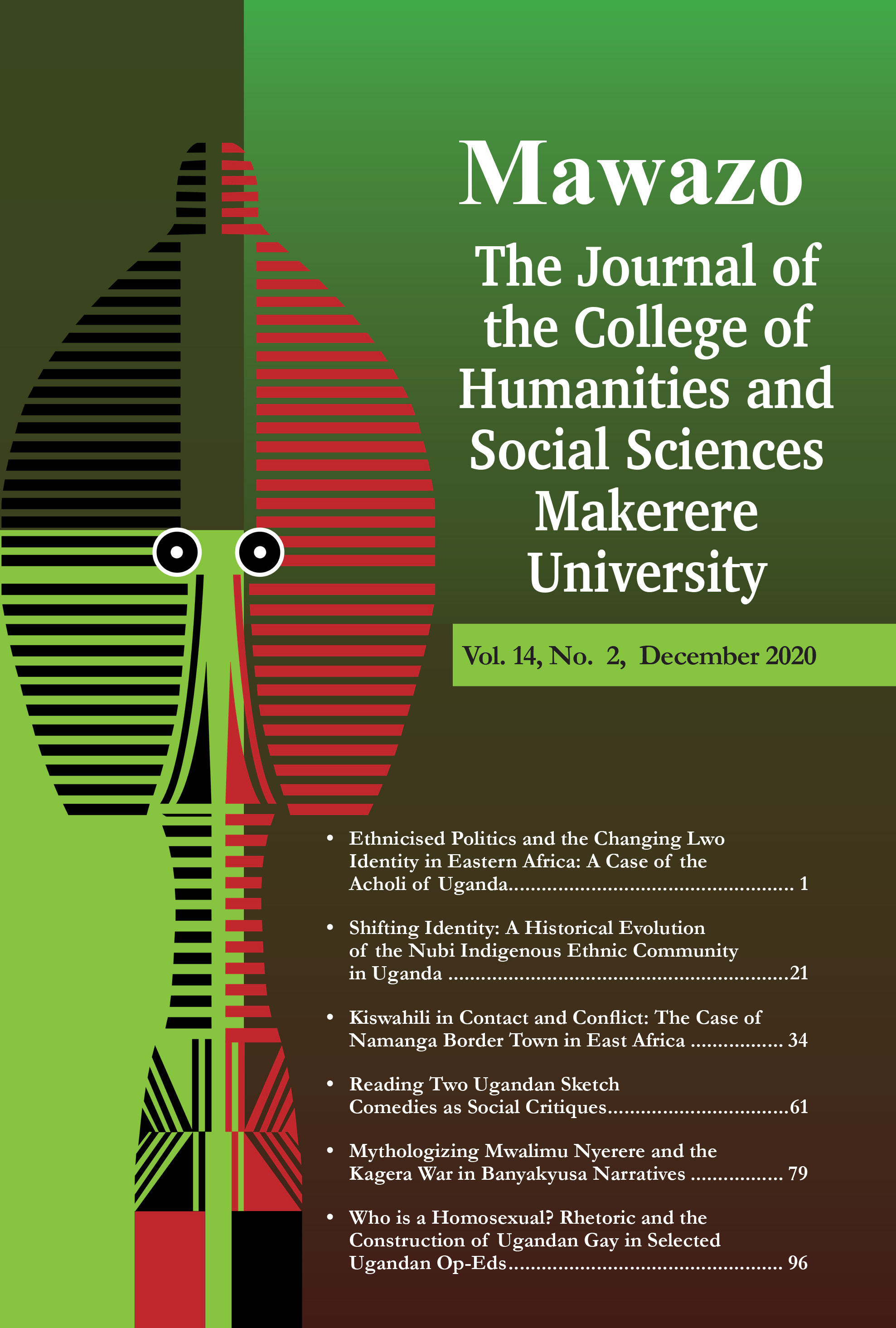
Volume 14, No. 2

Published December 31, 2020

Articles

  1. Ethnicised Politics and the Changing Lwo Identity in Eastern Africa: A Case of the Acholi of Uganda

    There is an astonishing difference between the image of the Acholi as portrayed by the early European visitors to eastern Africa and that offered by Uganda’s post-colonial politicians. Modern scholarship on the Acholi has generated prejudices, stereotypes and occasionally, damaging ethnic categorisations and labelling. Similar scenarios have been reported about other Lwo peoples in South Sudan, Ethiopia, the Democratic Republic of Congo and Kenya. This research analyses the ways in which divisive-regional and ethnicised politics have affected the image of the Acholi of Uganda over the years. I have reviewed relevant literature, conducted archival research, and key informant interviews to investigate the ways in which divisive politics have been damaging to Acholi identity.

  2. Shifting Identity: A Historical Evolution of the Nubi Indigenous Ethnic Community in Uganda

    The article examines how the Nubi who arrived in Uganda in the 1890s as a British colonial regiment of hired Sudanese soldiers, evolved into an indigenous community of Uganda by 1995. The article attempts to answer a key question: What caused the ever-changing Nubi identity during different historical situations in Uganda? Using oral narratives and information from different archival documents, the article argues that by the time the Nubi were recognized as one of Uganda’s indigenous communities, various factors under different historical contexts, accounted for their ever-changing identity.

  3. Kiswahili in Contact and Conflict: The Case of Namanga Border Town in East Africa1

    Language conflict is commonly studied and understood as an outcome of contact between speakers of different languages. In this article, we explore language conflict in the conversations of speakers of a sole language – Kiswahili. We argue that language conflict can as well occur among speakers of the same language. Using sociolinguistic data collected ethnographically among ordinary speakers of Kiswahili at the Namanga border town in East Africa, we show that these conflicts arise as a result of issues such as (i) citizen mobility, (ii) existence of several varieties and labels, (iii) varying attitudes of people towards different varieties, and (iv) demonstrating linguistic power. Consequently, we demonstrate that contrary to the assumptions of many scholars of Kiswahili and others, the Namanga border town bares a perfect example of a space in East Africa where meaningful and informative studies relating to different sociolinguistic aspects of Kiswahili, such as contact and conflict can be undertaken.

  4. Reading Two Ugandan Sketch Comedies as Social Critiques1

    YouTube, Facebook, and WhatsApp – among other social media platforms – circulate many sketch comedies by Ugandan artists, such as Siraje Sebbanja (stage name: Muzei Kalali), Allan Mujuni (stage name: Amooti Omubalanguzi), Dickson Zzizinga and Anne Kansiime, to mention but a few. This article investigates the manner in which two of these comedies – “Embaga ya Mayor” and “Kwanjula kw’Omuyaaye Ganja” – offer social critiques on pertinent issues in the Ugandan society. Through a close reading of the comedies, while cross-referencing them to other Ugandan oral and written literary texts, and interviews with selected people, I tease out what I consider the major critiques of some aspects of Ugandan society. In the two works I focus on, as well as the major dramatic techniques the directors of the works use to carry their message across to the intended audiences, I discuss each comedy’s major theme and the techniques used to develop it. It is my hope that this article will draw attention to Ugandan sketch comedies as material worthy of scholarly investigation.

  5. Mythologizing Mwalimu Nyerere and the Kagera War in Banyakyusa Narratives

    Mwalimu Juilius Kambarage Nyerere is widely regarded as the advocate of peace and stability in Tanzania and beyond. However, the critics of his legacy claim that the Kagera War between Tanzania and Uganda of 1978-1979 represents a contradiction with Nyerere’s commitment to peace and harmony. As Commander in Chief, Nyerere led Tanzanians and (some) Ugandans to fight the war against Idi Amin Dada. A lot that has been written about Nyerere’s motives for waging the war in the official narratives about the war. However, little is known about the perception of local Tanzanians on the nature of the war and Nyerere’s actual role in it. This article, uses a Banyakyusa poetic narrative “Ubwite bwa Kagera” (The War of Kagera) to examine Banyakyusa process of mythmaking about Nyerere’s perceived involvement in the Kagera War. The article argues that the Banyakyusa narratives present Nyerere as a superman, a demi-god who had mystical abilities, which enabled him to defeat Idi Amin decisively, but also as one who desired a peaceful settlement of the conflict. For the Banyakyusa, it was Idi Amin’s murderous disposition that made Nyerere declare the Kagera War to protect the innocent people of both Tanzania and Uganda.

  6. Who is a Homosexual? Rhetoric and the Construction of Ugandan Gay in Selected Ugandan Op-Eds

    Leading scholars of media and public discourses such as Nancy Frazer (1992) and Michael Warner (2002) have variously argued that the media cannot be neutral when the issue under debate is an explosive subject such as sexuality, race, or gender. Deploying textual analysis, I apply Frazer’s and Warner’s point that the media advances particular points of view to a collection of op-eds that discuss homosexuality in one Ugandan newspaper and one news magazine – Daily Monitor and The Independent – to uncover the image of this subject that emerged from these texts between December 2013 and June 2014. My textual analysis concludes that while most of the op-eds allegorised homosexuality in order to comment on ‘larger and more important’ issues affecting the Ugandan polity, some texts depicted homosexuals as either pariahs or perverts.