Skip to main navigation menu Skip to main content Skip to site footer

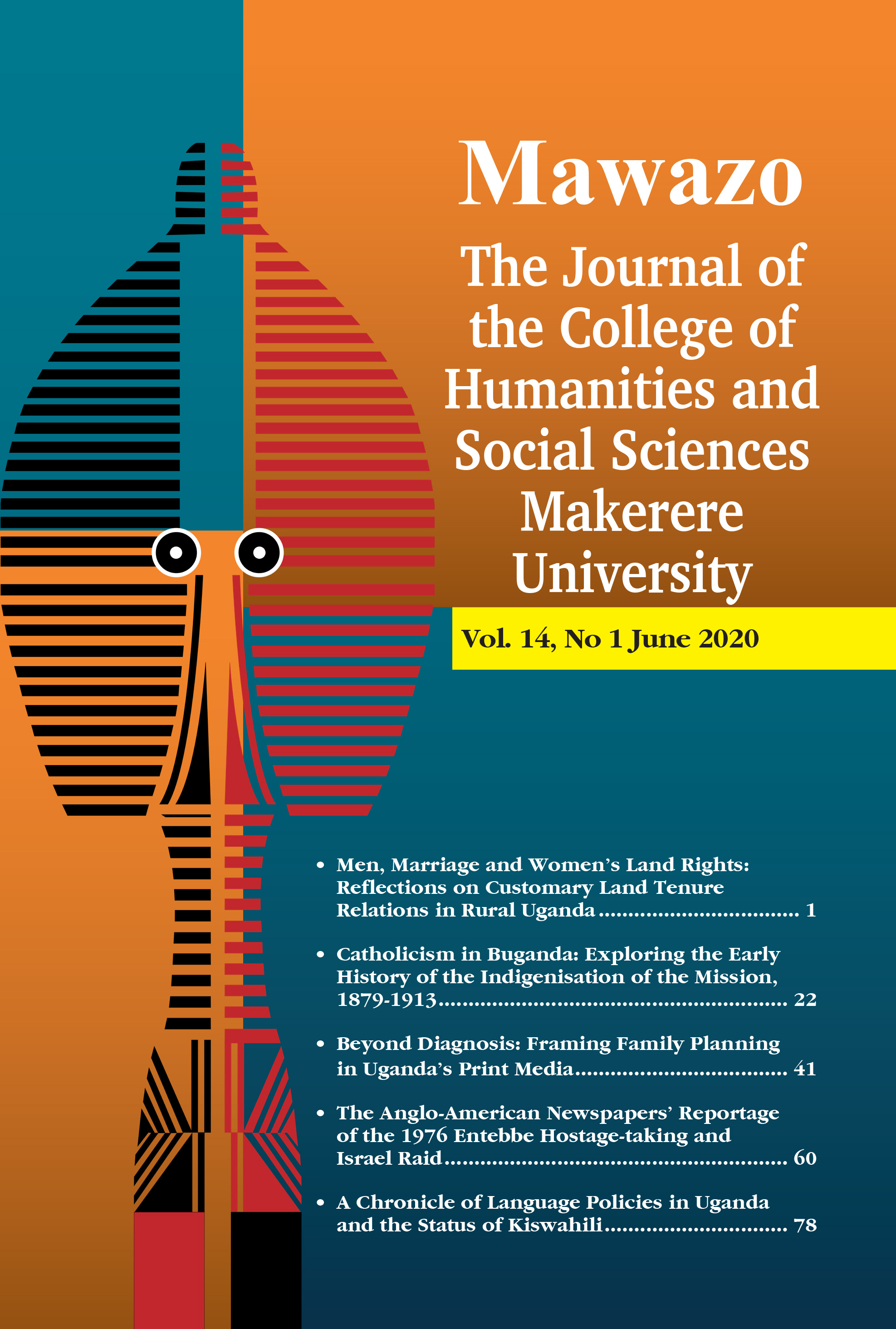
Volume 14, No. 1

Published June 30, 2020

Articles

  1. Men, Marriage and Women’s Land Rights: Reflections on Customary Land Tenure Relations in Rural Uganda

    In broad activist and policy formulations, customary land tenure is cast as severely inimical to women’s land rights. This article makes a case for closer interrogation of the reality of customary land tenure as an overly fluid nature in Uganda’s land governance. This article seeks to contribute to the debate on the gendered complexities of land rights in the realm of customary land tenure and its multi-layered dynamics especially in the context of marriage. The article’s core argument is that the reality of the fluidity Uganda’s gendered land access and ownership rights, labelled as a customary tenure, requires careful interrogation. Ultimately, there is need to avoid orthodox perspectives that might end up masking the multiple layers of agency available to women and men in specific contexts.

  2. Catholicism in Buganda: Exploring the Early History of the Indigenization of the Mission, 1879-1913

    The ordination of the first two Baganda priests: Bazilio Lumu and Victoro Womeraka Mukasa at Villa Maria (Buddu County) on June 29, 1913 has been hailed in much of Uganda’s Christian historiography as the ‘beginning’ of the indigenization of the Catholic mission in Buganda and Uganda as a whole. In this article, I use a historical and descriptive approach and draw on archival sources, field interviews to argue that the indigenization of the Catholic mission in Buganda began almost as soon as the first Catholic missionaries arrived in the country in 1879. I further argue that the early indigenization achievements of the Catholic mission in Buganda were occasioned by the vision, attitude, and evangelization methods of Charles Cardinal Lavigarie and members of his White Fathers’ Congregation, the zeal of the first Baganda Catholic converts who were ready to evangelize their kinsmen and the religio-political events that unfolded in Buganda between 1884-92. The article illustrates the earliest intersection of Kiganda culture and Roman Catholicism, and how this shaped the unicity of the mission that emerged in Buganda in the first three decades of the Catholic missionary presence.

  3. Beyond Diagnosis: Framing Family Planning in Uganda’s Print Media

    Family planning promotion through the press is a popular development strategy in Africa. However, few studies have examined how print media content on family planning is framed. Premised on the framing theory, this article examines how two newspapers, namely The New Vision and the Monitor in Uganda frame news on family planning. A summative content analysis was conducted on 45 articles using pre-determined diagnostic frames that define a problem, prognostic frames that offer a solution and motivational frames that call for action. The findings reveal that most news adopted the diagnostic frame yet more motivational and prognostic news framing could stimulate the demand for family planning services.

  4. The Anglo-American Newspapers’ Reportage of the 1976 Entebbe Hostage-taking and Israel Raid

    Several high-profile hijackings occurred in the 1970s and were covered by the media. One such hijacking was of the French Airbus A300 Flight 139 by the Popular Front for the Liberation of Palestine (PFLP) on 27 June 1976. In this article, I examined the causes of the nature of newspaper reportage of the June/July 1976 hijacking and hostage-taking involving an African state under President Idi Amin whose actions in the affair drew international attention to Uganda. Drawing on archival data, the paper article analyses the four newspapers’ portrayal of the Entebbe hostage-taking from 28 June to 3 July 1976 and the subsequent Israel Raid on 4 July 1976. The newspapers’ focused on are, the New York Times, The Guardian, The Times (London) and the Christian Science Monitor. In this article, I argue that the four newspapers’ reportage ranging from hostage-taking to the rescue depended on the political and social contexts under which they operated at the time, namely, the Cold War politics of the time. The newspapers focused covered more about on the rescue and its aftermath than the events leading to the hijacking and hostage-taking which obscured a clear understanding of the deeper causes of the Palestinian-Israeli conflict that used Idi Amin and Uganda as a pawn.

  5. A Chronicle of Language Policies in Uganda and the Status of Kiswahili

    Uganda’s history regarding the search for a national language has been characterised with by different language policies across different historical periods. These include both macro and micro policies that have had an impact on the promotion and development of Kiswahili in Uganda. Mainly, in the pre- colonial period, there was an unwritten policy in Buganda which gave Luganda, Kiswahili, and Arabic official language status, but following the declaration of Uganda as a British protectorate in 1894, the language policy changed from Kiswahili, Luganda, and Arabic to English as the official language. This examination of historical evolution of language policies demonstrate the bottlenecks that Kiswahili language has encountered in its promotion and development in Uganda. This is mainly attributed to colonial language policies that have influenced policy decisions across the different periods of time in Uganda’s history. This article, therefore, examines a historical narrative on different language policies that have been proposed in Uganda across the different historical periods, namely, the pre-colonial period (1844-1894); the colonial period (1894-1962); and the post-colonial period (1962-2005). These periods represent historical milestones during which different language policies were proposed about Kiswahili. The article critically examines those different policies and how they affected the Kiswahili Language, and it seeks to demonstrate that language policy in Uganda needs re-thinking.